The Market Case for Honey in Recovery and Rehydration Products
Product developers in active wellness and adjacent categories are moving away from synthetic ingredient lists toward natural ingredients with documented bioactive properties, a clean-label story, and verifiable supply chains.
Honey sits at the intersection of all three requirements. What makes it commercially relevant is not just the category positioning. It is the documented properties of specific honey varieties, and what those properties mean for product formulation at a technical level.
This post covers what the research indicates, which honey varieties are relevant to this product category, and how private label formulation through Honey X gives brand builders access to both the supply and the development capability to bring a credible product to market.
What the Research Indicates
Honey has been the subject of considerable research interest in the context of carbohydrate delivery and physical performance. The University of Memphis conducted a 64km cycling trial in which honey was found to perform comparably to synthetic carbohydrate gels as a fuel source across the duration of the event.
The carbohydrate profile of honey is a key reason for this. Honey is approximately 80% carbohydrates, composed of roughly 35 to 40% fructose and 30 to 35% glucose. This profile is relevant to product developers building in categories where carbohydrate delivery and dose are central formulation considerations.
Dose also matters. Research indicates that a 60g dose delivers a more meaningful response than a 30g dose. For sachet format decisions, this is a directly applicable data point. The 30g sachet format available through Honey X aligns with the higher end of the dose range indicated in the literature.
On the rehydration side, a study on Acacia honey found that participants who consumed honey before a second run covered approximately 10% farther compared to those who consumed water alone. This is a documented observation about performance across a second exercise bout. It is the kind of data point that product developers in this category need to understand when evaluating honey as a natural ingredient.
Why WA Honey Varieties Are Relevant to This Category
Not all honey is equivalent from a formulation standpoint. The bioactive compound profile varies significantly by botanical source, geography, and production method.
WA honey is produced in one of the world's most biosecure beekeeping environments. Over 80% of WA's honey-producing forests remain untouched by development. Beekeeping in WA is conducted without antibiotics, chemical treatments, or artificial feeding. This matters to product developers because it means the bioactive compound profile of the raw material is consistent and uncontaminated across supply.
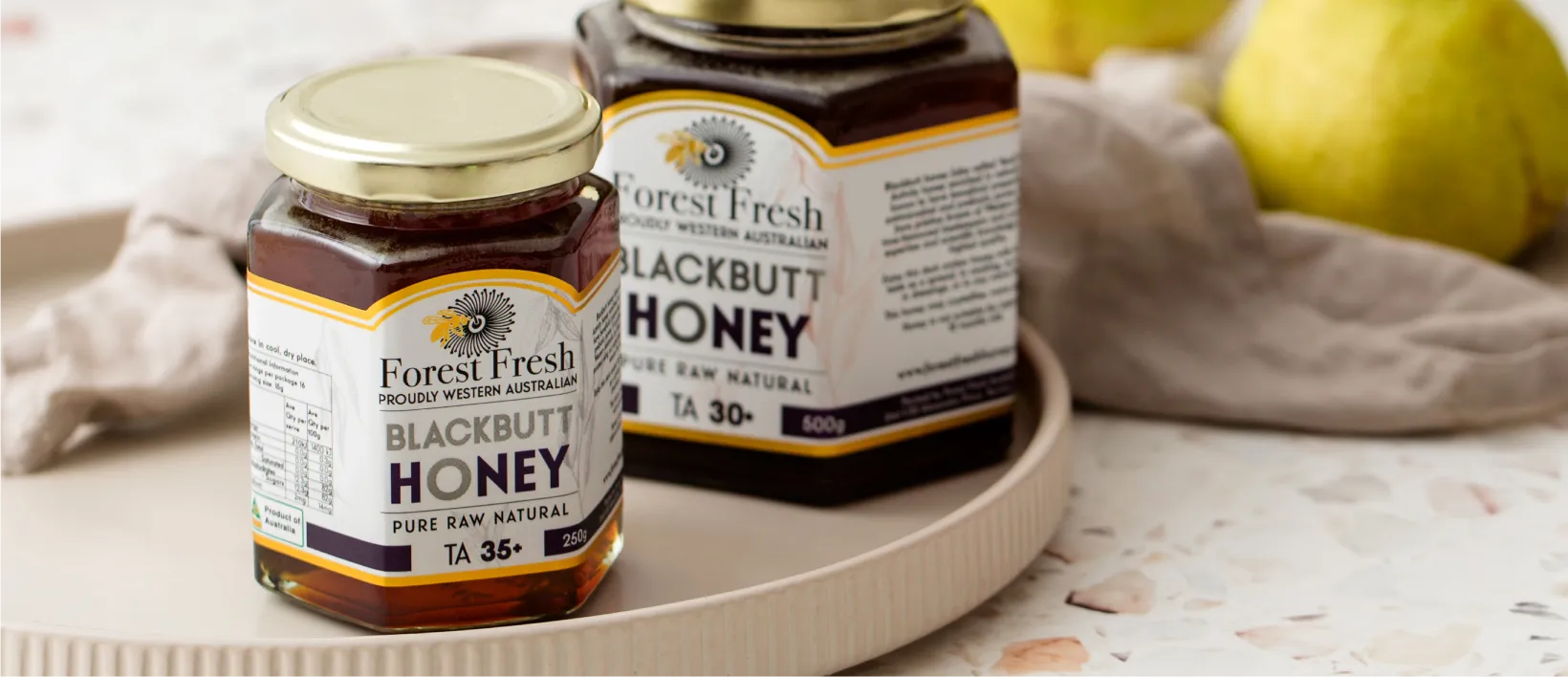
Western Australian honey varieties, particularly Jarrah and Yarri (Blackbutt), carry meaningful polyphenol and flavonoid concentrations that have been verified through third-party testing. Yarri (Eucalyptus patens) is notably rich in antioxidant and antibacterial compounds. Jarrah (Eucalyptus marginata) carries high Non-Peroxide Activity alongside a documented antioxidant profile.
These are not marketing assertions. Honey X products are tested and third-party verified at Analytica (ALS), ChemCentre, and the University of Sydney. The 153+ third-party tests conducted across five independent laboratories provide the kind of documented evidence base that brand builders in regulated and semi-regulated product categories need to reference.
Jarrah Honey: The Low GI Base
Jarrah honey carries a low glycaemic index of 46, independently trialled and validated under the Glycemic Factor™ for the Jarrah TA50+ grade. This is a clinically trialled figure, not a category estimate. For product categories where GI positioning is commercially relevant, this is a formulation-level advantage with documented evidence behind it.
Jarrah's low GI is a product of its natural sugar composition. Its high fructose to glucose ratio results in slower glucose release, and it is the same compositional feature that prevents crystallisation, underpinning the Crystallisation-Free Guarantee™. For infused product development, a base that does not crystallise and carries a clinically trialled GI of 46 is a meaningful formulation asset.
Jarrah is available in grades from TA15 through TA55+, all independently tested under the Well-Diffusion Phenol Equivalent (WDPE) methodology. Read more on how WA honey performs as a performance ingredient in published data.
Sachet Format: The Right Delivery Format for This Category
Product format is as important as ingredient selection. Single-serve delivery is the established standard across active wellness and on-the-go product lines, and the sachet format is well suited to honey-based formulations.
Honey X produces sachets across a full range of sizes: 8g, 10g, 13g, 20g, 25g, and 30g, giving product developers genuine flexibility in dose and format design. Film is produced in PET/ALU/PET/PE/ALU construction with gravure printing, and up to five unique designs can be produced per film order.
The high-speed sachet line operates at up to 25,000 units per day. First order timelines run to 12 to 14 weeks. Repeat orders run to 4 to 6 weeks. Sachet products can also be packed into doy pouches (130mm x 50mm x 180mm, holding 10 sachets) for retail-ready or wholesale presentation.
Contract packing is available for buyers who hold their own honey supply and require a HACCP-accredited facility for production.
Custom Formulation Capability
The product opportunity in this category is not honey in a sachet in isolation. The most credible products combine honey with other natural ingredients to create a formulation that is both scientifically grounded and market-positioned for a specific context.
Honey X works with any raw natural bark, powder, or extract to develop custom infused formulations. The brief comes from the buyer. The development comes from the Honey X team.
The in-house team specialises in formulation and development at both a scientific and infusion level, and at the level of current trend and market fit across key regions, through to market entry positioning. A buyer does not need to arrive with a complete product specification. They need to arrive with a market need. The team's role is to close the gap between that need and a production-ready SKU that enters the market correctly.
This capability is not widely available in the honey supply industry. Most honey suppliers supply honey. Honey X supplies formulation, documentation, packing, compliance, and export-ready delivery. The difference is significant for brand builders operating in markets where consumer expectations around provenance, bioactivity, and clean-label formulation are high.
The Broader Market Opportunity
The global natural health product market was valued at USD 23.5 billion in 2023 and is projected to reach USD 38.5 billion by 2033, growing at a 5.3% compound annual growth rate. Within this market, bioactive honey occupies a growing segment that is underpinned by third-party testing data rather than category-level claims.
Brand builders who enter this category with a formulation built on verified WA honey have a differentiated story. That story holds in premium retail, foodservice formats, and export markets where provenance and supply chain documentation matter to buyers.
The Fewster family has been producing and exporting WA honey since 1916, now in its fifth generation. The supply consistency and scientific credibility behind the ingredient are backed by a 100-year operational track record and 153+ third-party test results across five laboratories.
Common Questions From Buyers in This Category
Can honey be used in rehydration product formulations? Honey has been studied in the context of exercise and fluid replacement. The Acacia honey study referenced in this post found participants covered approximately 10% farther in a second run compared to water. The carbohydrate profile of honey, approximately 80% carbohydrates with roughly 35 to 40% fructose and 30 to 35% glucose, is the basis on which formulation developers are exploring honey as a natural ingredient in this product category.
What makes WA honey relevant to product formulation in this space? WA honey varieties, particularly Jarrah and Yarri, carry documented polyphenol and flavonoid concentrations alongside a well-characterised carbohydrate profile, all verified through independent third-party testing. The clinically trialled GI of 46 for Jarrah Platinum TA50+ and the antioxidant capacity of Yarri are the primary formulation reasons WA honey is of interest to product developers in this category.
What dose format does the research support? The available data indicates 60g is more effective than 30g. Honey X sachet formats go up to 30g per serve, and product developers can consider multi-sachet protocols or the jar and PET formats for higher dose applications.
Enquire About Custom Formulation for Your Market
If you are developing a product in the active wellness or natural ingredient category and want to understand what WA honey can contribute at a formulation level, the starting point is a conversation with the Honey X team.
Honey X operates across 17+ markets and supplies buyers from bulk ingredient sourcing through to fully packed, export-compliant private label products. The team can advise on honey variety selection, dose format, ingredient compatibility, and market entry positioning relevant to your target region.
Enquire about custom formulation for your market, or view the active WA honey range to understand the ingredient options available.