Why Western Australian Honey Is Globally Significant
Western Australia is home to one of the world's most biosecure and scientifically documented honey industries. The active honeys produced in WA's south-west forests, primarily Jarrah, Marri, and Yarri, are graded using independently verified Total Activity (TA) scores and supplied to buyers in 17 or more international markets.
What distinguishes WA honey from other premium honey origins is not provenance alone. It is the scientific framework applied to every batch: verified TA grades, independent laboratory certificates from accredited third-party labs, and a traceable supply chain from forest to finished product.
This overview covers the industry's key characteristics: its floral sources and production environment, the biosecurity conditions that shape its quality, the grading and testing framework, the heritage behind the supply chain, and the export dynamics that define WA honey's position in global markets. For detailed information on the Honey X business and team, see the About page.
WA's Honey-Producing Forests: Ancient, Rare, and Untouched
The three principal active honey varieties produced in Western Australia each come from a distinct floral source:
- Jarrah (Eucalyptus marginata): Graded TA15 through TA55+. Jarrah honey is characterised by high Non-Peroxide Activity (NPA), a low glycemic index, and natural resistance to crystallisation. It accounts for 73% of Honey X's export volume.
- Marri (Corymbia calophylla), also known as Red Gum: Graded TA30+. High Total Activity with strong peroxide-based bioactivity. A distinctive deep colour and robust flavour profile.
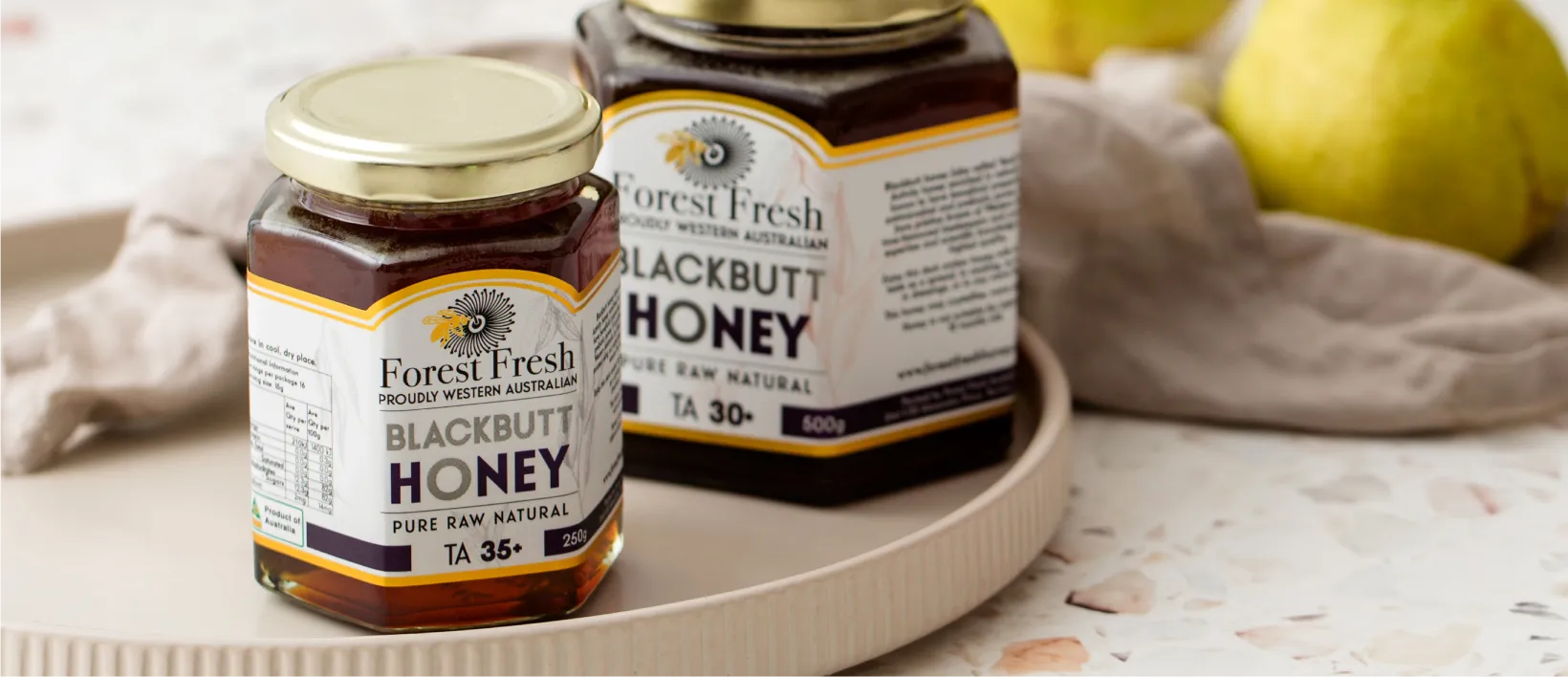
- Yarri (Eucalyptus patens), also known as Blackbutt: Graded TA30+. Rich in antioxidants and antibacterial compounds.
- Forest Blend: A multi-floral WA blend available for buyers who require consistent volume at accessible grades.
These varieties are not interchangeable. Each has a distinct bioactivity profile, flavour characteristic, and market application. Buyers sourcing for health food, food manufacturing, or premium retail channels typically specify grade and variety rather than sourcing on price alone.
The Jarrah forests themselves are over 1,000 years old. Jarrah trees flower only once every two to four years, making each harvest cycle a genuinely limited-volume event. There is no mechanism to artificially increase supply. This natural ceiling is a defining commercial reality for buyers seeking consistent access to high-grade Jarrah honey.
Biosecurity: The Environmental Advantage Behind WA Honey
Western Australia's beekeeping industry operates within one of the world's most biosecure production environments. Over 80% of WA's honey-producing forests remain untouched by human development. The isolation of WA's south-west forests, combined with strict state-level biosecurity controls, has maintained the region free of several honey bee diseases and pests that affect production elsewhere.
Beekeeping in WA is conducted without antibiotics, chemical treatments, or artificial feeding. This is not a marketing position. It reflects the regulatory and environmental conditions under which WA apiculture operates. WA is one of the few places in the world where beekeeping operates at commercial scale without antibiotic use.
For buyers in markets with strict import residue limits, including China, the UK, and the USA, this is a material compliance advantage. The absence of antibiotic use removes one of the most common sources of regulatory rejection for imported honey. Buyers who have encountered residue-related import issues with honey from other origins will understand the significance of a supply chain that operates without these inputs by default, not by exception.
WA honey's moisture content sits at 15 to 17%, lower than the up to 20% typical in colder or more humid climates. Lower moisture content contributes to a more shelf-stable product and is a factor in the antimicrobial effectiveness of WA active honeys. The honey is antibiotic-free and residue-tested at batch level before export.
Grading, Testing, and Verification: The TA Framework
WA active honey is graded using the Total Activity (TA) scale, which measures the combined antimicrobial strength of a honey sample. TA incorporates both Peroxide Activity (PA) and Non-Peroxide Activity (NPA), giving a composite bioactivity score that reflects performance across both antimicrobial mechanisms.
The standard test method is the Well-Diffusion Phenol Equivalent (WDPE) test, conducted by placing diluted honey into a petri dish infused with Staphylococcus aureus bacteria and measuring the diameter of the bacteria-free zone after 24 hours. The result is expressed as the equivalent phenol concentration required to achieve the same antimicrobial effect. This is the same methodology used to verify Manuka honey grades in New Zealand and is the accepted standard for expressing antimicrobial strength in numeric terms.
The TA scale for WA honey:
- TA10+: Moderate activity
- TA20+: Strong activity
- TA30+: Highly active
- TA40+: Exceptional activity
- TA50+ and above: Elite grade
- TA55+: Highest grade verified in supply
Honey X tests at three independent laboratories: Analytica (ALS) in New Zealand, ChemCentre in Western Australia, and the University of Sydney. All testing is third-party and batch-specific. No marketing claim about activity is made without a current laboratory certificate to support it.
The Jarrah Factor™ is a proprietary grading system developed by Honey X Chief Scientific Officer Mike Fewster. It extends beyond a single TA score to incorporate antimicrobial strength, antioxidant levels, and sugar composition into a composite quality indicator specific to WA Jarrah honey. This gives buyers a more complete picture of product quality than any single metric can deliver.
Full product specifications and batch-level test data are available to registered wholesale buyers via the active Western Australian honey product category.
WA Honey and Manuka: Complementary, Not Competing
WA active honeys are positioned as complementary to Manuka honey, not competing against it. Both are premium bioactive honeys with independently verified activity profiles. The frameworks used to measure and express that activity are different, and understanding the difference helps buyers make informed sourcing decisions.
Manuka honey is measured primarily by Non-Peroxide Activity (NPA), UMF, and MGO (Methylglyoxal). MGO is the dominant NPA driver in Manuka and can develop as honey ages, but it can also degrade over time. WA honey's framework uses Total Activity (TA), which combines both PA and NPA. The dual mechanism of WA Jarrah honey, which achieves meaningful NPA alongside PA, gives it a broad-spectrum stability that is different in origin from Manuka but equally rigorous in its verification.
For buyers already sourcing Manuka, WA honey adds a complementary product with a distinct activity mechanism and a different origin story. Jarrah honey's NPA is not MGO-driven. Its verified TA50+ grade is equivalent to MGO 4000+ on the Manuka scale. TA35+ is comparable to MGO 2000+. These are not claims of superiority. They are reference points for buyers who need to translate between two different grading frameworks.
For a detailed comparison of both grading systems, see the WA honey vs Manuka comparison post.
The Fewster Family: Five Generations of WA Beekeeping Since 1916
The Fewster family began beekeeping in Muchea, Western Australia in 1916, when John Fewster and his brother Robert established the first hives. Robert had immigrated from England in 1898 and passed away in 1921. What followed was more than a century of continuous operation through five generations.
Jim Fewster and his brothers Nelson, Norman, and Arthur carried the tradition forward through the mid-twentieth century. Alan Fewster dedicated his working life to beekeeping. Mike Fewster, fourth generation, holds a Bachelor's and Master's degree in Applied Science and built a career spanning chemistry, analytical methods, and numerical modelling before rejoining the family business, driving international sales into North Asia and the UK, and ultimately taking the Chief Scientific Officer role at Honey X. His scientific background underpins the Jarrah Factor grading system and all in-house screening protocols.
Matt Fewster, fifth generation and founder of Honey X, identified gaps in WA honey education and international trade during a period of work in Saudi Arabia and founded the business to address them directly. His background spans metal fabrication, beverage manufacturing, and international honey exports. His role is commercial: export development, product innovation, international sales, and brand building. He is not a beekeeper. He is a trade strategist and product developer.
Third and fourth-generation descendants of the family remain active in commercial beekeeping operations. The result is a supply chain where scientific rigour and generational experience exist in the same business, not as separate credentials but as a single operating framework.
Honey X Export Operations: Markets, Formats, and Logistics
Honey X is the wholesale and export division of Forest Fresh Honey, operating under the parent entity Forest Fresh Australia Pty Ltd. It is a B2B trade platform, not a consumer brand. Every service is designed for buyers: importers, distributors, private label brand builders, retailers, and food manufacturers.
Current export volume breakdown:
- 73% Jarrah honey by volume
- 16% Marri (Red Gum) by volume
- 11% other varieties including Yarri and Forest Blend
Honey X serves 17 or more markets globally and is a registered importer for China, the UK, the USA, and Saudi Arabia under Forest Fresh Australia Pty Ltd. Export freight options include sea freight and air freight. Trade terms available are Ex-Factory, FOB, DDU, and CIF. The business also provides tariff management and quota reduction support for buyers navigating complex import requirements.
Bulk supply is available in 14kg cubes, 28kg pails, 300kg drums, 1400kg IBCs, full pallets, and full container loads. Private label, contract packing, and retail-ready brand distribution are available as additional service layers for buyers who need more than raw commodity supply. For buyers requiring export logistics support, the export service page covers registered markets, freight terms, and the documentation framework.
Honey X Certifications: 12 or More, Across Domestic and Offshore Standards
Honey X holds 12 or more certifications across domestic and offshore accreditation standards. These include:
- HACCP: foundational food safety management standard for commercial production
- BQUAL: the Australian honey industry's quality assurance programme
- Organic certification
- Great Taste Awards recognition
- BICWA Asian Apiculture first prize (2024)
- Multiple offshore accreditations for specific export markets
For buyers sourcing for regulated markets in China, the UK, or the USA, the relevant offshore accreditations can be confirmed via the customer portal after registration. Certification documents and batch-level test certificates are available to approved wholesale buyers.
The Global Natural Health Market and WA Honey's Position in It
The global natural health product market was valued at USD 23.5 billion in 2023 and is projected to reach USD 38.5 billion by 2033 at a 5.3% compound annual growth rate. Bioactive honey occupies a growing segment within this market, driven by buyer demand for ingredients with documented antimicrobial credentials and traceable provenance.
WA active honey sits within this market as a documented bioactive ingredient with independently verified grades, a biosecure production environment, and a consistent testing framework. It is not positioned as a generic honey category. It is positioned as a tested, graded, traceable active ingredient relevant to buyers in health food, food manufacturing, and premium retail.
The Crystallisation-Free Guarantee™ is Australia's first guarantee of non-crystallising Jarrah honey, backed by the natural fructose-to-glucose chemistry of the variety. For buyers in export markets where crystallised honey creates logistical challenges or retail presentation issues, this is a supply quality guarantee with direct commercial value.
The Glycemic Factor™ supports buyers positioning Jarrah honey in health food or low-GI product categories, with independent test data available to substantiate the claim at the batch level. The Goodness Factor™ combines antimicrobial activity, antioxidant capacity, and quality indicators into a single composite metric for buyers who require an overall quality signal alongside individual test results.
Register for Wholesale Access
Honey X connects international buyers with verified WA honey: Jarrah, Marri, and Yarri, independently tested and export-ready across 17 or more active markets. Five generations of Fewster family beekeeping since 1916, backed by third-party verified science from Analytica (ALS), ChemCentre, and the University of Sydney.
Register for wholesale access to explore varieties, grades, and export options. Batch-specific test certificates and pricing are available to approved buyers via the customer portal. Enquire about export logistics or explore the full range via the active WA honey product category.